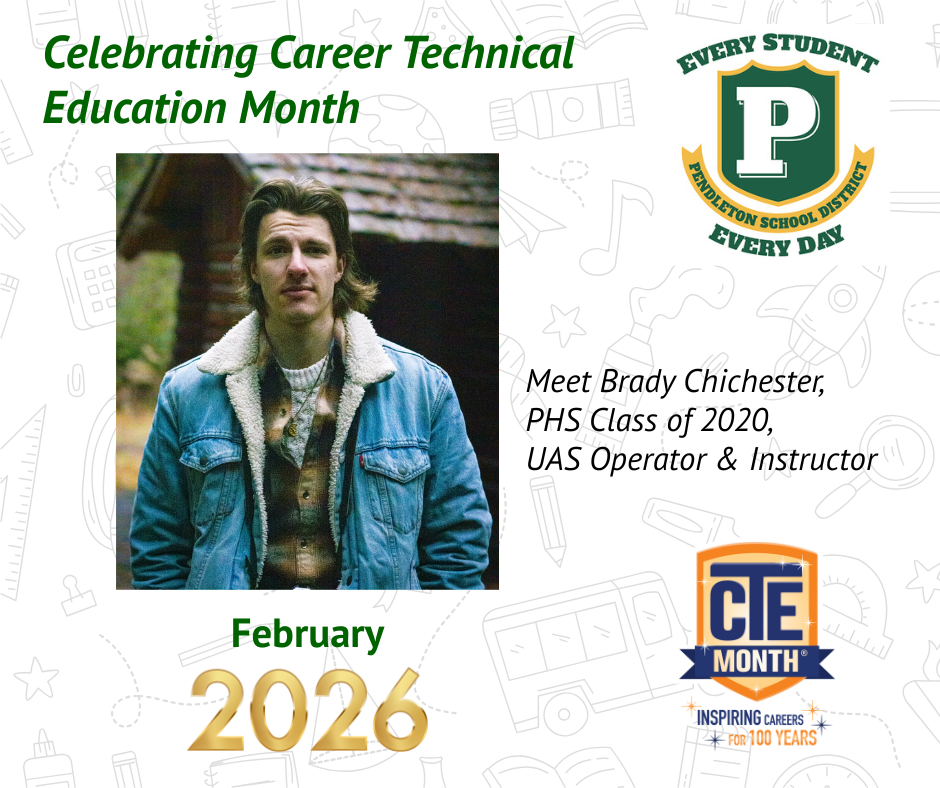
CTE Month – February 2026 Spotlight: Brady Chichester
CTE Month – February 2026
Spotlight: Pendleton High School Graduate Brady Chichester
During Career Technical Education (CTE) Month, Pendleton High School reached out to a few PHS graduates who are working in CTE fields. Brady Chichester, PHS Class of 2020, is a UAS (Unmanned Aircraft System) Operator and Instructor for Delmar AeroEducation, part of Delmar Aerospace based in Nevada. Chichester works at the Pendleton Airport.
As a student at PHS, Chichester was first introduced to UAS through a Military Science class, which included a tour of the Army National Guard facility and conversations with UAS operators. “That sparked my initial interest in UAS and led me to seek out the nearest college program after I graduated, which happened to be Central Oregon Community College (COCC) in Bend, as BMCC did not yet have a UAS program,” he said.
Chichester earned a degree in Unmanned Aerial Systems Operations, which took about two years to complete. The coursework included a mix of UAS-specific classes, aerodynamics, meteorology, and GIS (Geographic Information Systems). He also had to take either a fixed-wing or helicopter private pilot class, which went more in depth than a UAS pilot typically needs, but he found it beneficial since he plans to earn his private pilot’s license in the future.
At Delmar Aerospace, he is the lead instructor for their Non-Credit Training Certificate (NCTC) course, which covers general aviation knowledge such as weather, airspace, and regulations, along with in-depth flight simulations that prepare students for real-world operations. Chichester is also helping create and prepare a new FPV (First Person View) drone course for an upcoming Department of Defense contract. Another recent project involved working with the AeroEnergy crew on methane detection at landfills using UAS.
“My job duties change from month to month, which keeps things interesting. Teaching and working with students takes up the majority of my time, but I still get the opportunity to take on different projects here and there to keep things interesting and even have the possibility of deploying overseas for extended periods.”
What is his advice for high school students interested in the UAS field? He recommends a strong foundation in engineering, robotics, computers, aerospace or related technical fields. “There are still plenty of strictly piloting jobs, but having those skills on top of flying will benefit you greatly. It can be a challenging industry to break into,” he said. He shared that another route that can provide valuable experience is flying UAS in the military, primarily with the Air Force or Army; this is especially helpful for deploying overseas for private companies, which can be a lucrative path.
Chichester also points to the Pendleton hometown advantage, which presents unique opportunities and accessible pathways into the industry. Students can gain valuable experience by interning either directly through the UAS accelerator or through BMCC’s UAS program. “These opportunities are a great way to make connections and begin building a professional network early,” Chichester said.
The UAS industry is rapidly expanding, Chichester continued, making this an excellent time to enter the field in whichever sector interests someone, whether that is oil and gas, defense, agriculture, or many other industries that rely on UAS. “Each industry offers opportunities that go far beyond flying, including roles in research and development, system testing, sales, instruction, and many areas in between. If you are interested in UAS, explore the different paths available, find the niche that excites you most, and get involved as early as you can.”